Tuesday, June 9, 2015

WELCOME TO MY (FUTURE) GARDEN


Baptisia x 'Purple Smoke'and just gathered salt marsh hay :)

DISCLAIMER: This has been a VERY VERY STRESSFUL spring for me so please forgive the colorful language that may be not so liberally sprinkled throughout this post.

Before I get started I'd like to wish a MASSIVE, GIANT, FLYING, F#@K YOU!!!!! to spring. All I wanted was just a month, just one little month of cool moderate temperatures and consistent rainfall. You know, kinda like the typical weather we get almost every spring... but apparently not this one. I was even a really good boy and got most of my seeding done before mid April. And just when I got most of my flats hardened off and ready to go we went from March temperatures in the 30s and 40s to July temps in 70s and 80s (apparently April and May got together and collectively decided they really needed a break this season). Oh, and not one spot of rain for almost 2 months (okay maybe there were a few spots, but not much more than that). Anywho, F@#$@@@#@@@@K YOU SPRING. F @ # $ @ @ @ # @ @ @ @ K!!! Y O U!!!.

Ok, now that that's out of the way, back to business. For the 2 people and my mom who actually read this blog, you may have noticed that for someone who is totally obsessed with plants, there is an alarming lack of my own garden pics sprinkled around here. Aside from being extremely insecure, this is mostly 'cause the last few years have been a bit of transition for me. Letting go of the place I gardened growing up (mainly cause there is simply nothing left to save at this point) and embracing my newly, officially adopted (as of now) garden home. In addition to developing a larger master plan for the property (which is currently mostly still all in my head) the last few years have consisted of dealing with the aftermath of a grant my family and I were lucky/"lucky" enough to receive from the Parker River National Wildlife Refuge that our property abuts. In all seriousness though... very happy we got it... I think.

This past weekend (of many, many weekends) spent weeding, planting, and watering was the first I can remember in a long time when my excitement about the future wasn't completely crushed by the life sucking vortex of anxiety born from being completely and utterly overwhelmed by the shear number of things to do. So it seemed like a good time to start sharing... at least before the vortex started swirling again. Also, if I'm being completely honest... I'm feeling just too damn lazy this week to search for inspiration and figured I'd go with what was right in front of me.

Just a little bit of background, part of my strategy for turning this property from a messy mosaic of mostly invasives and a few sporadic natives to a (at least partially) cultivated and at least mostly self-sustaining "native" landscape is identifying as many of the native trees and wildflowers that are already on site and not only encouraging and propagating these species, but using them as a means of understanding the properties past and getting a sense of where its headed. Considering there's about 6 acres to work with (+ adjacent conservation land) the list is pretty substantial. Here are some of the highlights as well as a few species I might be able to integrate into the various niches I'm both creating and attempting to enhance.


Cornus alternifolia - Pagoda Dogwood
Zones 3-8
Purchase from: American Beauties, A Nearly Native Nursery, Cold Stream Farm, Forestfarm, Lazy S'S Farm & Nursery, New England Wetland Plants, Prairie Moon Nursery, Tree Seeds, White Oak Nursery

This is perhaps the most distinctive species on the property, and you can spot it from a mile a way (okay maybe a few hundred feet, but still quite an impact). The distinctive, symmetrical, tiered branching is unlike any other tree found in our region. Aside from the most recent incident of my dad accidentally burning a 15 foot specimen (yes Dad, I noticed....and you will be lectured thoroughly...), I plan to use the seedlings sprouting up around existing established trees throughout the property as much as I can. A truly magnificent small tree.


Sabal minor 'McCurtain' - McCurtain Dwarf Palmetto
Zones 5b-10 (possibly solid zone 5 once established)
Purchase from: Brian's Botanicals, Plant Delights Nursery, Alligator Alley

After seeing images of this palm throughout swamps in the south, coupled with the availability of a seed strain from the northern most known population I couldn't resist. Maybe I'll have myself my own little population of Dwarf Palmetto in a few years... or not. We'll see.


Amelanchier canadensis - Canada Serviceberry
Zones 4-8
Purchase from: Accents for Home and Garden, Cold Stream Farm, Greenwood Nursery, New England Wetland PLants, Prairie Moon Nursery, Shooting Star Nursery

This guy has been a bit ubiquitous in landscape trade as of late (although its mostly A. arborea and its hybrids, A. x grandiflora). I "discovered" aka finally stopped overlooking a large specimen on the property a couple of years ago that had been pretty much slapping me in the face every time I got out of the car. Only after researching how to make cuttings of this species did I find a massive treasure trove of seedlings littering the understory (along with a few other older specimens sprinkled around the edges of the property). These little guys will never make it in the midst of established trees, so I'm gonna relocate a few to sunnier areas where they can prosper. Clay/shade tolerant, and unlike most of the cultivars you'll find at your local nursery, this local genotype seems to be almost entirely cedar rust resistant. I actually bought A. x grandiflora 'Robin Hill' several years back only to have it be completely decimated by cedar rust.


Maianthemum canadense - Canada Mayflower
Zones 3-8
Purchase from: Nasami Farms, Sunshine Farms and Gardens

I still feel REALLY shitty about where my family ended up having to put our leach field, which was basically smack-dab in the middle of an existing grove of established red maples, and a lush monolithic carpet of Cinnamon Fern (Osmunda cinnamomea) and Canada Mayflower (Maianthemum canadense). The later is a diminutive and and unassuming wildflower that goes largely unnoticed, but is deserving of much wider use in the industry. In addition to doing my best to encourage and replace that which was lost, I thought I'd pay homage to this under-appreciated staple of the northeast woodland.


Penstemon hirsutus - Hairy Beardtongue
Zones 3-9
Purchase from: Diane's Flower Seeds, Everwilde Farms, Prairie Moon Nursery, Shooting Star Nursery, Sunlight Gardens

This plant definitely falls under the category of "happy accidents" and you gotta celebrate those when they happen. 99.99999% of my accidents are almost always unhappy. Anyway, I grew this penstemon species from seed on a whim planning on planting it out on a nearby exposed rocky hillside. Me, being who I am, ran out of time, and threw them in to some random corner of our meadow/garden because I refuse to let any plant die under my care. They were sad scrappy little seedlings that (I thought) had zero chance of making it. Especially when you consider that they were planted in heavy, like really heavy clay (everything I read about them said they preferred a lean, well-drained soil). Low and behold, not only did they survive, but they seem pretty damn content!! I'm officially done taking the word of gardening books and nurseries at face value. I find more and more often that my own experience directly contradicts most of what's out there in the literature.


Iris versicolor - Northern Blue Flag
Zones 4-9
Purchase from: Amanda's Garden, American Meadows, Companion Plants, Everwilde Farms, High Country Gardens, Morning Sky Greenery, New England Wetland Plants, Niche Gardens, Northcreek Nursery, Prairie Moon Nursery, Shooting Star Nursery, Sunlight Gardens, Toadshade Wildflower Farm, Yellow Springs Farm

By no means rare, I was excited to find one lonely individual growing on the edge of stand of phragmites, where the shade cast by a large red maple suppressed the growth of the phragmities just enough, while at the same time letting in just enough light for this one iris to hang on. I have since divided it and moved a few bits to a slightly sunnier area where it thanks me in late spring with a few flowers. I know of an existing colony a few towns over where I'll be collecting seeds this summer to try to give this lonely survivor a few friends. I imagine this lone individual is the last hold out of a pre-existing colony that was pushed out by what I not so affectionaely call "the devil's reed" (aka Phragmities australis). Since I can't really do justice to the cultural and ecological complexity/weight that comes along with this speices I thought I'd let this VERY local guy do it for me... and yes, he is awesome.


Thursday, April 30, 2015

'CAUSE CRACK (AND SEEDS) ARE CHEAP. VERY CHEAP.


I'm on the verge of a nervous breakdown, I'm barely sleeping, I'm losing weight, my family is concerned, I haven't showered in I don't know how long, and I smell... like really really bad, like REALLY bad. All these things together can only add up to one thing... SPRING IS HERE!!! Yes, now that the danger of last frost is only a few weeks away I am confronted with with the full horrific reality of what I have done.
S O O O... M A N Y... S E E D S...
Oh god. So many. How did this happen?!! What was I thinking?!! Is there an army of secret garden gnomes that I've enslaved under mind control somewhere and forgot about? Yes that must be it. Secret slave garden gnomes. Now if I can just remember where I left them... under my bed maybe?... hmmmmmm...

While I consider the alternate realities in which secret slave garden gnomes might actually be a thing, I also have to continually remind myself why it is that I do what I do. When it comes down to it some of the most significant and stunning interactions I've witnessed and observations I've made have all happened while gardening. They vary from the weirdly violent to sublimely beautiful. This includes (while I'm ashamed to admit it) accidentally running over a brood of (fairly large) baby snakes with a lawn mower (luckily there were only a few causalities and yes I wanted to cry when it happened), who's remains were quickly dragged away (still wriggling mind you) by a pack of big hungry wolf spiders. This is in very stark contrast to the first time I saw a Hummingbird Clearwing Moth, aka Hemaris thysbe zipping around one of my little stands of Ballon Flower (Platycodon grandiflorus) and realized exactly what I was looking at (granted the video below isn't the same species, but it does a great job at illustrating the evolutionary elegance of this group of insects that starkly contrasts to what we think of when we hear the word "moth")


Working outside in the garden is the one thing that makes me feel like I have some sort of (while perhaps superficial and tenuous) connection to the place where I grew up. More importantly it drives home that point that however careful, or seemingly insignificant our impacts, whenever we modify the places we live to suit some need, or idealized aesthetic we affect the interactions that would normally occur. While I feel the default for most contemporary landscapes is to reduce, simplify, and often totally eliminate these relationships, it should be our ultimate goal as gardeners and designers to encourage, create, and diversify these exchanges, embedding richness in and around our lives and the lives of the organisms we (sometimes reluctantly) co-exist with. I can only hope that sum total of my own impacts will be a net positive in the long run.

And in an attempt to move in the "net positive" direction I thought I'd highlight a few underutilized natives that are also great pollinator magnets. Sooo without further adieu I give you the plants:


I've fallen in love with this aster over the past few years. It's easy going nature, clay tolerance, pale blue flowers, and critter resistance make it a winner as far as I'm concerned. Definitely underutilized (assuming I've ID the species correctly).
Symphyotrichum (formerly Aster) prenanthoides - Zigzag or Crooked-Stemmed Aster
Zone: 3-8

Purchase from: American Meadows, Prairie Moon Nursery, Prairie Nursery, Roundstone Native Seed Company, Shooting Star Nursery, Toadshade Wildflower Farm


An unassuming plant on its own, but viewed in mass in the wild it can be rather stunning. Spring ephemeral. The only member of this genus growing in the northeast. Check it out.
Cammassia scilloides - Wild Hyacinth
Zone: 4-8

Purchase from: Enchanter's Garden, Everwilde Farms, Prairie Moon Nursery, Sunshine Farm and Gardens


Another great naturalizer! Spring ephemeral. Take a look.
Delphinium tricorne - Dwarf Larkspur or Spring Larkspur
Zone: 3/4-8, no source out there seems to be consistent on this. Best guess

Purchase from: American Meadows, Enchanter's Garden, Lazy S'S
Farm Nursery
, Prairie Moon Nursery, Sunshine Farm and Gardens


RIGHT, LEFT
Helianthus angustifolius 'Mellow Yellow'/Helianthus giganteus 'Sheila's Sunshine'

Anyone who knows me well, knows I'm not a big fan of yellow. Yes, I know its trivial and superficial, but I kind of feel like it's the neon flashing sign of the floral world, the color most plants default to when evolution got lazy and was like "eeeh, good 'nough." But, given that I don't feel a list of great pollinator plants would be complete with out at least a few sunflowers, I've come across these cultivars of 2 of our native species a few years back that have beautiful pastel yellow flowers. Less a "slap you in the face yellow" and more of a "fuzzy baby chick you want to pick up and cuddle yellow".... think I might have to use that the next time I'm in the paint section at the hardware store, just to see what kind of reaction I get from whatever poor soul got stuck working that day.

H. angustifolius 'Mellow Yellow' - Mellow Yellow, Swamp Sunflower or Narrow-Leaved Sunflower
Zone: 6-9

Purchase from: Niche Gardens
*Theres an additional soft yellow cultivar of H. anustifolius called 'Matanzas Creek'

H. giganteus 'Sheila's Sunshine' - Sheila's Sunshine, Giant Sunflower or Tall Sunflower
Zone: (5)6 to 9

Purchase from: Digging Dog Nursery, Niche Gardens, Quackin Grass Nursery


This is one of my few exceptions to my "yellow rule." Grew up with it around the ole homestead and distinctly remember the hoards of bumblebees that always seemed to accompany the flowers every summer. A more than slightly aggressive spreader, roamer, and romper. So consider yourself warned. Most, if not all of the material available is a cultivar called 'Fireworks' or as it was originally known 'Fyrverkeri.'
Oenothera fruticosa - Sundrops
Zone: 4-8

Purchase from: Almost Eden, Digging Dog Nursery, Dutch Gardens, Lazy S'S
Farm Nursery
, Midwest Groundcovers, North Creek Nursery, Plant Delights Nursery, Plant World Seeds


RIGHT, LEFT
Pycnanthemum incanum/P. muticum
Variations on the same theme, P. incanum (right) can take more sun and driers soils, while P. muticum (left) can take more shade and slightly wetter soils. All of the species in this genus are great nectar plants.

Pycnanthemum incanum - Hoary Mountain Mint
Zone: 5-8

Purchase from: Plant Delights Nursery, Niche Gardens, Toadshade Wildflower Farm

Pycnanthemum muticum - Short Toothed Mountain Mint
Zone: 4-8

Purchase from: Almost Eden, Avant Gardens, Lazy S'S
Farm Nursery
, Niche Gardens, North Creek Nurseries, Shooting Star Nursery, Van Berkum Nursery, Yellow Springs Farm


RIGHT, LEFT
Salvia azurea/S. reptans
2 similar species, with S. reptans being slightly more delicate and airy, having darker blue/violet flowers, and also being less hardy than S. azurea.

Salvia azurea - Pitcher Sage, Blue Sage, Azure Sage
Zone: (4)5-9

Purchase from: Nearly Native Nursery, Accents for Home and Garden, Everwilde Farms, Gardens in the Wood of Grassy Creek, Prairie Nursery, Prairie Moon Nursery, Odyssey Perennials, Shooting Star Nursery, Smart Seeds
*S. azurea 'Nekan' and S. 'Grandiflora' are superior selections of the species.

Salvia reptans aka S. leptophylla - Cobalt Sage or Slenderleaf Sage
Zone: (5)6-9, again sources not consistent with this one

Purchase from: High Country Gardens, Lazy S'S
Farm Nursery
, Odyssey Perennials
S. reptans 'West Texas Form' is superior to the species.


Okay, so one more exception to my yellow rule. Lustrous, deep green foliage, very non-typical for a goldenrod. Clumper, but will re-seed. There's a native stand of these guys growing very contentedly in almost pure clay back home.

Solidago speciosa - Showy Goldenrod
Zone: 3-8, again sources not consistent, best guess

Purchase from: Amanda's Garden, Everwilde Farms, Ion Exchange, Morning Sky Greenery, Prairie Nursery, Prairie Moon Nursery, Shooting Star Nursery


This picture does not do this plant justice. Take a look.
Sanguisorba canadensis - American or Canadian Burnet
Zone: 3-7

Purchase from: Enchanter's Garden, Prairie Moon Nursery, Shooting Star Nursery, Van Berkum Nursery

IMAGE SOURCES: creepy garden gnomes, Symphyotrichum (formerly Aster) prenanthoides, Camassia scilloides, Delphinium tricorne, Helianthus angustifolius 'Mellow Yellow', Helianthus giganteus 'Sheila's Sunshine', Oenothera fruticosa, Pycnanthemum incanum, Pycnanthemum muticum, Salvia azurea, Salvia reptans aka S. leptophylla, Sanguisorba canadensis

*Ten million life bonus points if you get the Whitney Houston reference. RIP.

Tuesday, March 31, 2015

NINJA GARDENING


IMAGE ABOVE: A nearly monolithic stand of Sorghastrum nutans aka Indiangrass at a road cut on my way to work. It surrounds an area of exposed bedrock where the soils are so shallow and dry that very little, if much of anything, is able to survive aside from the Indiangrass.

Sorghastrum nutans - Indiangrass
Zone: 3-9

Purchase from:
Agrecol Native Nursery, Everwilde Farms, Garden Harvest Supply, Grimm's Gardens, Morning Sky Greenery, Prairie Nursery, Prairie Moon Nursery, Shooting Star Nursery, Toadshade Wildflower Farm, Yellow Springs Farm Native Plant Nursery

I'm still amazed at the diversity of habitats in the few miles of my short bike ride to work. You'd never guess by the pictures of above, but these were taken only a few miles from downtown Cambridge, MA. In the twenty minutes it takes me to get to work I get a small sampling of nearly all the non-coastal habitats in northeast Massachusetts. Yet it is this diversity that not only astounds me, but reminds me of the complex interconnected matrix upon which species diversity, population health, and sustainability relies. Yet, with each passing year, this matrix becomes increasingly patchy and disconnected, particularly in the coastal US.


IMAGE ABOVE: When examined discretely, development and general population growth are damaging to the genetic diversity of local populations, but when you take into account the affect that such impediments and barriers have on gene flow and the ability of a population to gradually migrate overtime, the cumulative affect of such factors may affect the long term sustainability of any given population.

We may like to disassociate and project "environmental villanism" to far away virgin tropical rainforest (cue b-reel of some rando buzzing through a tree), but the reality is every time we decide to clear some local parcel for a nice water guzzling invasive monoculture, aka lawn, we are much more guilty than that guy with the chain-saw. He's doing it to make a living.... so what's our excuse?

So faced with this not so nice reality I've decided to take it upon myself to act as a modern day Noah, aka human corridor (see diagram above), ferrying what would otherwise be isolated, often endangered plant populations to un-populated habitats ripe for colonization. Such areas are often diversity barren due to the fact that they themselves have been ecologically sterilized by means of human induced isolation. I realize there are many valid arguments against this, the first and foremost being my own lack of expertise. However, in my attempt to aid in the healthy diversity of these isolated habitats and ecological communities I don't plan on trekking through virgin ecosystems and digging up rare or endangered species and relocating them, but rather collecting the local seed of common (or the occasional not so common) wildflowers I find on the side of the road (or perhaps ordering a seed or two from a nursery), and introducing them in areas where they have a good chance of establishing long lasting, and sustainable populations.

And so for my first attempt at being a garden ninja the isolated stand of Indian grass I featured above (location undisclosed) seemed like a great place to start, and a perfect case study. Road bound on every side, and nearly a monoculture of S. nutans (with a few sporadic Andropogon mixed in) and not having a habitat equivalent for miles, I run the least risk of jeopardizing the genetic integrity of any nearby sensitive populations. Given how isolated this particular site is, and the fact that it's entirely man made to begin with, I also plan on experimenting with a few Western natives that might be able to thrive where the soils are simply too shallow and exposed for any of our locally endemic species to endure. Below is the list of natives (and native-ish) plants I intend to use, hopefully with at least some success (you may notice a trend with a lot of the plants I've selected.... what can I say, hummingbirds are f*@#ing awesome!!!).


NORTHEAST NATIVES


Aquilegia canadensis - Canada Columbine
Zone: 3-8

A few different cultivars available on the market including 'Corbet,' 'Little Lanterns,' and 'Pink Lanterns.' The straight species is still the most commonly sold form and is available from almost every nursery specializing in natives.
Purchase from: Nearly Native Nursery, Amanda's Garden, American Meadows, Bluestone Perennials, Everwilde Farms, Garden in the Wood of Grassy Creek, Grimm's Gardens, High Country Gardens, J. L. Hudson Seedsman, Lazy S'S Farm, Michigan Native Butterfly Farm, Niche Gardens, Prairie Moon Nursery, Prairie Nursery, Select Seeds, Grimm's Gardens, Shooting Star Nursery


Asclepias tuberosa - Butterfly Weed
Zone: 3-9

Color variants exist, leaning from deep yellow to red-orange, but most of the material out there is derived from ecotypes found in sandy soils. If you garden in heavy clays (like me) a few nursery's offer material adapted to heavier soils.
Purchase from: Nearly Native Nursery, Accents for Home and Garden, Almost Eden Plants, American MeadowsAvant Gardens, Companion Plants, Deer Country Gardens, Everwilde Farms, Garden Crossings, Garden Harvest Supply, Garden Starts Nursery, Gardens in the Wood of Grassy Creek, Grimm's Gardens, High Country Gardens, J Lynn Nursery, J.L. Hudson Seedsman, Lazy S'S Farm, Logee's Greenhouses, LoneWillow Farm, Michigan Native Butterfly Farm, Niche Gardens, Prairie Nursery, Romence Gardens & Greenhouses's, Rose Franklin's Perennials & Herbs, Santa Rosa Gardens, Select Seeds Antique Flowers, Smart Seeds, Sooner Plant Farm, The Growers Exchange, Toadshade Wildflower Farm, Yellow Springs Farm Native Plant Nursery, Prairie Moon Nursery, Prairie Nursery


Ionactis linarifolia - Stiff Aster
Zone: Sources all over the place witht this one... 3-8?

Purchase from: Midwest Groundcovers, Prairie Moon Nursery, Shooting Star Nursery


Opuntia humifusa - Eastern Prickly Pear
Zone: 4-9

Purchase from: Nearly Native Nursery, Everwilde Farms, Fry Road Nursery, Romence Gardens & Greenhouses, Toadshade Wildflower Farm


MID-ATLANTIC/SOUTHERN NATIVES


Ipomopsis rubra - Standing cypress
Zone: (5)5-9
, (BIENNIAL)
Purchase from: Nearly Native Nursery, Everwilde Farms, J.L. Hudson Seedsman, Onalee's Seeds, Select Seeds Antique Flowers, Smart Seeds


Manfreda virginica - False Aloe
Zone: 6-9

This isn't the best picture of this plant (all you can see is the tall flowering stalk in the center of all the people), but after growing this plant myself, and seeing it in this picture next to other moisture loving species in what appears to be a wet meadow I'm beginning to think this agave relative needs more moisture than the literature suggests.
Purchase from: Companion Plants, Lazy S'S Farm, Niche Gardens, Odyssey Perennials, Shooting Star Nursery


WESTERN NATIVES


Agastache rupestris - Sunset Hyssop
Zone: 5-9

Purchase from: Annie's Annuals and Perennials, High Country Gardens, J.L. Hudson Seedsman, Joy Creek Nursery, Lazy S'S Farm & Nursery, Michigan Native Butterfly Farm, Romence Gardens & Greenhouses, Sooner Plant Farm


Castilleja integra - Wholeleaf Indian Paintbrush
Zone: 4-8

C. coccinea is a more commonly available biennial that is unfortunately difficult to establish in cultivation. C. integra is one of the easier perennial species to start with.
Purchase from: Everwilde Farms, Cactus Store


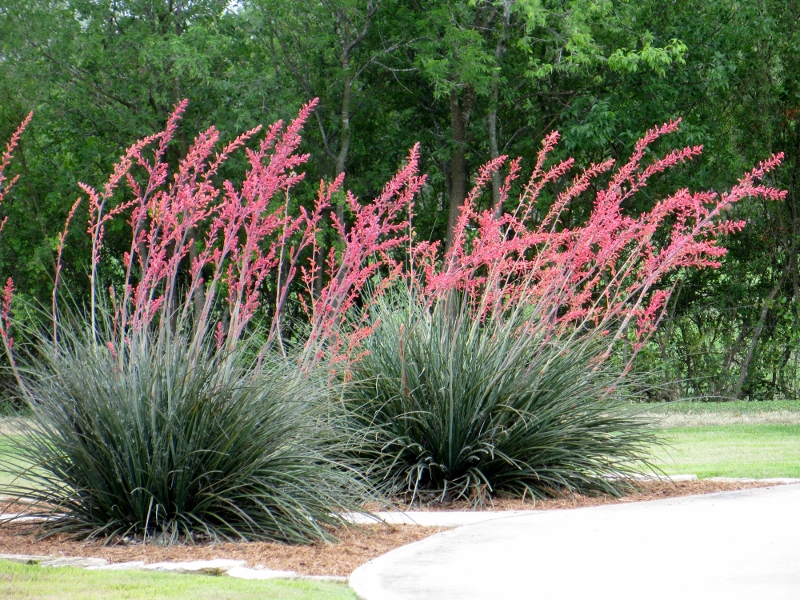
Hesperaloe parviflora - Red Flowered Yucca
Zone: 5-10

Purchase from: Accents for Home and Garden, Almost Eden Plants, Annie's Magic Garden, Dancing Oaks Nursery, Eldon Tropicals's, High Country Gardens, J.L. Hudson Seedsman, Lazy S'S Farm, Niche Gardens, Smart Seeds, Sooner Plant Farm


Penstemon pinifolius - Pineleaf Penstemon
Zone: 5-8

High country gardens has selected several cultivars of this species for both color (ranging from a a clear yellow to deep red) and height.
Purchase from: Annie's Annuals and Perennials, Forestfarm, Gardens in the Wood of Grassy Creek, High Country Gardens, Joy Creek Nursery


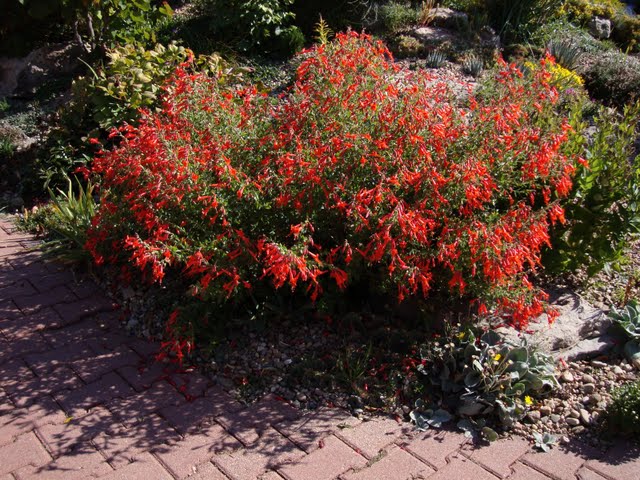
Zauschneria spp. (arizonica/garrettii) - Hardy Hummingbird Trumpet
Zone: 5-9

Z. arizonica, syn. Z. latifolia var. arizonica
Purchase from: Forestfarm, High Country Gardens
Z. arizonica syn. Z. canum subsp. garrettii
Purchase from: High Country Gardens, Joy Creek Nursery, Romence Gardens

IMAGE SOURCES: MATRIX-PATCH HABITAT, A. CANADENSIS, A. TUBEROSA, I. LINARIFOLIA, O. HUMIFUSA, I. RUBRA, M. VIRGINICA, A. RUPESTRIS, C. INTEGRA, H. PARVIFLORA, P. PINIFOLIUS, Z. ARIZONICA