Wednesday, May 31, 2017

Sunday, April 30, 2017
Friday, March 31, 2017
OH DEAR, OH DEAR, OH DEAR, OH DEAR, OH DEER!!!!

They've just about beaten me this time. One gardener can only take so many setbacks (after setback, after setback, after setback... you get the idea). I seem to be stuck on a perpetual cycle of getting all hyped about a plant only to have my dreams shattered when it gets munched to the ground. I'm not naive about it, I read up, do my homework, but you soon learn that calling a plant deer resistant, and it actually being that are 2 very different things.
The worst thing about it is that I'll sometimes spend years raising a plant from seed (again after finding multiple sources that say deer won't touch it) and after going an entire season without a nibble, suddenly, next season the deer decide to change things up and it gets devoured. Needles to say I'm scraping the bottom of the barrel as far as plants go that won't immediately become another scrumptious menu item on the deer buffet that is my garden. I even had trouble with them eating milkweed and wild onion last year, which are both said to be "deer proof". So without any new natives to try (I've literally experimented with just about every regionally endemic deer resistant plant at this point) what's one to do?... answer: nurse plants!
Now, I may have kind of ripped this term off (I think its usually used to refer to plants that get planted with desirable semi-parastic species), it definitely works here. Lately I try to use species that are known specifically for deterring deer and "borrow" their protective properties and set plants that usually wouldn't have a shot when grown on their own, in and among them. So if you are like me and won't have the funds for a deer fence for a very, very, very long time, and screaming and running after the deer like a crazy person isn't quite doing the trick (not that I do that on a weekly basis or anything..) you might as well give some of these guys a try. About half of these plants I've grown personally, and the remainder I'll give a try this season. As with many of the deer deterring plants most of them are in the mint family, so if they meet that criteria, and have a reputation for deterring deer, chances are they actually do. Let me know if I'm wrong.

Agastache feoniculum - Anise Hyssop
Zones 3-8
I'm trying this guy out for the first time this season. I've avoided this species in the past for 2 reasons. The first being I have super clay-ey and seasonally saturated soils (this guy supposedly hates clay) and the second being that it is apparently an aggresive reseeder and can get upwards of 4 feet so would eat any other small plants around it. But I recently came across a strain (Agastache 'Select Blue' offered by
Specialy Perennials that is supposedly clay tolerant and super hardy. Given the wide range of this plant in the wild (from coast to coast) I imagine its much more adaptable than given credit and is simply a function of provenance. Proabably a lot of untapped potential for the selection of superior and variant forms. Other than this strain the only other I've come across is 'Blue Spike' (here, here, or here) if your looking for something for a smaller garden. THE plant for pollinators.
Purchase from: Ion Exchange, Morning Sky Greenery, Prairie Moon Nursery, Almost Eden Plants, Amanda's Garden, American Meadows, Colonial Creek Farm, Companion Plants, Everwilde Farms, High Country Gardens, J.L. Hudson Seedsman, Joy Creek Nursery, Michigan Native Butterfly Farm, Select Seeds, Sow True Seed, Prairie Nursery

Euphorbia corollata - Flowering Spurge
Zones 3-9
As much as I would like to grow this plant, probably not gonna happen anytime soon. But if your lucky enough to be blessed with good drainage and a sunny spot, and also have a deer problem definitely give this one a try.
Purchase from: Prairie Moon, Avant Gardens, Everwilde Farms, Heritage Flower Farm, Lazy S'S Farm, Niche Gardens, Plant Delights, Midwest Groundcovers, Ion Exchange, Rare Find Nursery, Agrecol
MONARDA
My love for this genus continues to grow with each passing year. Also seems to be going through a bit of a renaissance lately, with a ridiculous number of hybrids and cultivars, although 'Jacob Kline' will always have my heart.

Monarda bradburiana - Bradbury's Bee Balm
Zones 4-8
My favorite of the bunch. Earliest blooming and virtually mildew free foliage. Great fall color.
Purchase from: American Meadows, Avant Gardens, Gardens in the Wood of Grassy Creek, Niche Gardens, Digging Dog, Prairie Moon, Rare Find

Monarda didyma - Scarlet beebalm
Zones 3-8
The best species for heavy wet soils. Red is the default, but there are varieties in everything from deep purple to bright pink. Hummingbird favorite.
Purchase from: Toadshade Wildflower Farm, Everwilde Farms, Prairie Nursery, Burpee, Outside Pride

Monarda fistulosa - Wild Bergamot
Zones 3-9
One of the easiest wildflowers you can grow. Takes a wide range of soils and smells amazing whenever you brush up against the foliage (as do pretty much all the monardas, but for some reason this species seems to be more fragrant to me).
Purchase from: A Nearly Native Nursery, Almost Eden Plants, Amanda's Garden, American Meadows, Colonial Creek Farm, Everwilde Farms, Gardens in the Wood of Grassy Creek, Grimm's Gardens, High Country Gardens, J.L. Hudson Seedsman, Michigan Native Butterfly Farm, Shady Oak Butterfly Farm, The Blooming Artichoke Herbary, The Growers Exchange, Toadshade Wildflower Farm, Prairie Nursery, Prairie Moon, Morning Sky Greenery

Nepeta subsellis - Japanese Catmint
Zones 4-8
Supposedly the best Nepeta for poorly drained soils, and actually appreciates some extra moisture (although not too much, seems to have rotted out in some of the wetter spots in the garden). Verdict is still out on this one, but hoping it really takes off this year. Starts flowering in late spring and (provided its happy) continues till frost.
Purchase from: Lazy S'S Farm & Nursery, Digging Dog Nursery
PYCNANTHEMUM
This genus has all the thugish-ness that the mint family is known for, so consider yourself warned before you decide to plant any of these species. Trying to attract pollinators?... look no further. This genus cannot be beat.

Pycnanthemum incanum - Hoary Mountain Mint
Zones 5-8
Probably the most tolerant of drier soils.
Purchase from: Niche Gardens, The Growers Exchange, Toadshade Wildflower Farm, Rarefind Nursery, Enchanter's Garden, Terrior Seeds

Pycnanthemum muticum - Short-toothed Mountain Mint
Zones 4-8
Will tolerate more shade and moisture than the other species (although P. tenuifolium tolerates a significant amount of wetness).
Purchase from: Accents for Home and Garden, Almost Eden Plants, American Meadows, Avant Gardens, Colonial Creek Farm, Lazy S'S Farm, Niche Gardens, Rose Franklin's Perennials & Herbs,
Select Seeds

Pycnanthemum tenuifolium - Slender Mountain Mint
Zones 4-8
I have grown this species in my own garden and it has self seeded faster than probably anything else I have grown. Beautifully scented, but a thug none the less.
Purchase from: Accents for Home and Garden, Almost Eden Plants, Avant Gardens, Companion Plants, Grimm's Gardens, Joy Creek Nursery, Morning Sky Greenery, Prairie Nursery

Salvia uliginosa - Bog Sage
Zones (6)7-10
Very blue and very pungent. One of 2 marginally hardy exotics I'm utilizing to keep the deer at bay and one of my all around favorite plants. Grows in just about any soil as long as it's not bone dry (but seems to love my wet clay). Attempting to grow from seed this season, although not much info out there on germination requirments. Super easy from cuttings.
Purchase from: Accents for Home and Garden, Avant Gardens, Colonial Creek Farm, Digging Dog, Gardens in the Wood of Grassy Creek, Joy Creek, Lazy S'S Farm, Plant Delights, Putnam Hill, Vincent Gardens

Salvia guaranitica - Anise-Scented Sage
Zones (6)7-10
Excited to try this marginally hardy salvia. Moisture lover, although dryness during the colder months is supposed to improve its cold hardiness. Trying a few varities including the most cold hardy (Argentine Skies). The most commonly offered 'Black and Blue' is probably one of the least hardy varities. Hoping they over winter for me, but will be allowing whatever I plant to cross polinate and try growing up the progeny next season.
Purchase from: Gardens in the Wood of Grassy Creek, Niche Gardens, Select Seeds
IMAGE SOURCES: Deer (TOP IMAGE), A. foeniculum (LEFT, RIGHT); E. corollata (LEFT, RIGHT, BOTTOM);) M. bradburiana (LEFT, RIGHT); M. didyma (LEFT, RIGHT); N. subsellis (LEFT, RIGHT); P. incanum; P. muticum; S. guaranitica (LEFT, RIGHT); S. uliginosa (LEFT, RIGHT)


Tuesday, February 28, 2017
THE STRUGGLE IS REAL... SO PLANT SOME SMELLY BULBS

REMNANT DEVIL TUNNELS
The hand ringing has started early this year for me. Given the freakishly hot February (I feel like I'm saying this more and more) all the snow is gone and the ground has pretty much entirely thawed a month a head of schedule. I took advantage of the early and extreme thaw to do my usual walk through and survey the damage after being away for 2 months. Between the frost heaves, deer trampling, woodchuck holes, and the reaffirmation that I have some of clay-eyist soils around after digging around a bit, I immediately went into gloom and doom mode, but after a few deep breaths and repeatedly reminding myself that February and March have come and gone before and the plants manage to survive just fine, I avoided a panic attack... that is until I saw the voles, or more precisely, what the voles had done.
Over the past few years I've been waging a violet inspired battle. Trying and failing to protect my Liatris, Iris, Dalea, Baptisia, ect.) against the many critters that call my garden home. But the most villainous of them all, the one that leaves so little trace of its victims that you start to convince yourself that you never planted them to begin with, is the insidious vole. The list of plants I can't grow because of them gets longer and longer with each passing season, but the latest casualty (the few last remaining clumps of Baptisia 'Purple Smoke' that I have waited years to reach maturity) pushed me over the edge. I suppose I should have seen it coming, this was the last of several clumps that the voles have been working through since they were planted. While I've at least partially accepted that the remaining Baptisia probably won't last more than another season or 2, I'm still going to do my best to defend them against the invading onslaught of furry little devils (including the various non-toxic chemical deterrents out there, like Repellex and castor oil. So in honor of this very worthy foe, I figured I'd list a few plants that supposedly help deter all pests of the 4 legged variety, but that also don't mind or even prefer a heavier soil (something that's a must in my garden).

Allium suaveolense - Odorous Garlic or Fragrant Leek
Zone: 4-8
Probably one of the more random plants I've come across in the rabbit hole that is the internet. One of a handful of allium species that can tolerate saturated soils. European native. Growing up a flats of these to test this season to see how well it fairs in my wet clay. Update to follow... As with all alliums, a good all around pest deterrent.
Purchase from: Specialty Perennials, Jelitto

Delphinium tricorne - Dwarf Larkspur or Spring Larkspur
Zone: 3/4-8, no source out there seems to be consistent on this. Best guess.
I've been looking for an excuse to grow this species as they take a few years from seed to reach flowering size, but given this genus' high toxicity I think I finally found a reason. The literature seems to suggest this species might be more tolerant of poorly drained soils, hoping for this along with some level of pest deterrence. Native spring ephemeral.
Purchase from: American Meadows, Enchanter's Garden, Lazy S'S Farm Nursery, Prairie Moon Nursery, Sunshine Farm and Gardens

Fritillaria meleagris - Checkered Lily or Snake’s Head Fritillary
Zone: 3-8
While unusual and exotic looking, this plant is by no means rare, and is offered by pretty much all the bulb companies out there. Appears to do well in any moist soil (provided it's not too acidic). Has the typical strong skunky smell of the genus and is great at repelling pests. Howeve,r asiatic lily beetles do love them, so if these are a problem in your area you may want to look elsewhere. But even with the lily beetle scourge these guys have persisted for 10+ years in a perpetually mucky spot.
Purchase from: Brent and Becky's Bulbs, McClure & Zimmerman, Van Engelen, K.Van Bourgondien & Sons, Etc.

Leucojum aestivum - Summer Snowflake
Zone: 4-8(9)
Probably one of the most versatile and adaptable bulbs I can think of. Falls into the same category as the previous plant (offered by pretty much all of the bulb companies out there), but still underutilized. As with all plants in the family Amaryllidaceae (this includes daffodils) pretty much vole immune. 'Gravetye giant' is a commonly offered variety that is larger and more vigourous than the species.
Purchase from: Brent and Becky's Bulbs, McClure & Zimmerman, Van Engelen, K.Van Bourgondien & Sons, Etc.
IMAGE SOURCES: TOP IMAGE; A. suaveolense (LEFT, RIGHT); D. tricorne (LEFT, RIGHT); F. meleagris; L. aestivum (LEFT, RIGHT);
Tuesday, January 31, 2017
THE GLASS IS HALF EMPTY, IT'S ALWAYS BEEN HALF EMPTY... AND WE'RE ALL SCREWED

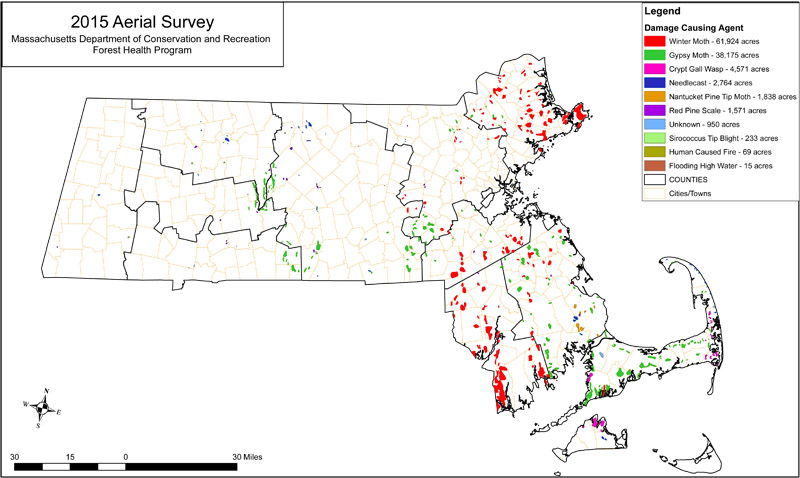
GYPSY MOTH OUTBREAK 2016 - THE BOSTON GLOBE
I've done my best to stay positive these past few months. My very, very, very, very best, despite every fiber of being trying to drag me down to wallow in all my fears, anxieties, and rage, but at this point I think I owe it myself to give in to the bottomless panic that's been threatening to swallow me whole. So for the moment I'm going to stop re-assuring myself that somehow everything will work out, that humanity will finally stop fumbling around in the dark and somehow manage to find its way out of the massive hole we've dug ourselves. Everything is not ok, we are all horrible, and each and every one of us is royally screwed. And so without further adieu I give you multiple (ecological) reasons to lie awake at night, knowing full well the future is not bright, and we are all collectively to blame (and for the record this is only a fraction of the human induced disease and infestations that are currently afflicting our forests here in the northeast. I chose to focus on either recently-ish introduced disease and pests or those that have, for whatever reason, yet to be widely publicized outside of the scientific community). Enjoy.

Disease/Pest: Geosmithia morbida, Thousand Cankers Disease
Description: A fungus spread by the Walnut Twig Beetle, Pityophthorus juglandis.
Primary species affected: Black Walnut, Juglans nigra & Butternut, Juglans cinerea
Mortality: ≈ 100%
Resistant varieties: None
Other Susceptible species: Juglans spp.
Year first reported and location: 2001, Colorado
Successful efforts to combat: Given the recent appearance of the disease there have been no coordinated efforts to fight back, simply curb the spread. Currently, there are no reported cases of resistant J. nigra individuals.

Disease/Pest: Butternut Canker, Sirococcus clavigignenti-juglandacearum
Description: A spore spread fungus.
Primary species affected: Butternut, Juglans cinerea
Mortality: ≈ close to 100% (with an occasional resistant individual)
Resistant varieties: None
Other susceptible species: Black Walnut, Juglans nigra
Year First reported and location: 1967 in southwestern Wisconsin
Successful efforts to combat: Yes, a germplasm of resistant Butternuts has been gathered by the forest service and partnership state and private organizations for breeding. While efforts are promising, they have yet to publicly release any resistant Butternut strains. To further complicate matters some resistant "Butternuts" were actually hybrids between J. cinerea and J. ailantifolia (Japanese Walnut).

The northeastern and mid-atlantic forest once had economic value far beyond the raw materials of the trees themselves. American Chestnuts, Butternuts, and Walnuts once sustained local people well beyond simple subsistence, forming the backbone of local economies up and down the eastern seaboard. But with the appearance of chestnut blight at the turn of the 20th century this economy quickly began to collapse as the once great American Chestnut went functionally extinct. While not as productive or as prevalent both the Black Walnut and Butternut (also highly valued for their nuts) are now at risk of succumbing to the same fate. The 2 diseases that threaten these trees highlight what exactly it is we lose when these foreign pathogens are unleashed upon an otherwise healthy functioning landscape: productivity. Natural systems that could once support diverse populations of native flora and fauna along with local human populations all but collapse leaving the disparate elements to compete for the few resources that remain.
Disease/Pest: Winter Moth, Operophtera brumata
Description: A moth native to Europe and the near East. Males are most commonly observed in late fall and early winter in the evening in search of flightless females.
Primary species affected: Multiple deciduous trees and shrubs including Acer spp., Quercus spp., Fraxinus spp., Malus spp., Vaccinium spp., etc.
Mortality: (?) less than 5% maybe, buy this is a total guess. It may indirectly be much higher (they weaken the trees and make them more susceptible to other disease).
Resistant species and varieties: Conifers
Year first reported and location: Nova Scotia sometime prior to 1950.
Successful efforts to combat: Yes, a parastic fly and natural predator of the moth (Cyzenis albicans) has been studied (see article), and appears to have successfully curbed infestations. It has already been used successfully in Nova Scotia and British Colombia, and results in the northeast look promising. The fly is a specialist and does not appear to target other native lepidoptera species. While not yet available to the larger public, UMass Amherst professor Joseph Elkinton has done several controlled releases across Massachusetts in hopes of curbing the outbreak (see article).

So I only found out recently that the multitude of moths I've been seeing fluttering around at night during the end of November are not only pretty much all the same species (and all male), but a noxious introduced pest that has been responsible for the (often) complete defoliation of a multitude of deciduous tree species, including many natives. This, along with 2 other introduced lepidoptera pest (Gypsy Moth, Lymantria dispar and Browntail Moth, Euproctis chrysorrhoea - both of which have their origins in my great state of Massachusetts...ugh) make a destructive trio that are wreaking havoc across the northeast and continuing to expand their range with each passing year. 2016 was a particularly bad year given the record setting drought (drought compounds the infestation as one of the few natural controls of these voracious little wrigglers is a virus, baculovirus, that relies on rainfall to spread). This confluence of accelerated population growth and extreme drought resulted in some pretty disturbing scenes. There were stretches along the drive to my garden (from Boston to Ipswich) this past summer where it looked like it was winter in mid-July. Thousands upon thousands of big mature oaks were stripped down to their bare branches for pretty much the entirety of the summer.
Disease/Pest: Woolly Adelgid, Adelges tsugae
Description: A miniscule sucking insect. Egg sacks are visible as white cottony masses.
Primary species affected: Tsuga canadensis
Mortality: ≈ 100%
Resistant varieties: None
Other susceptible species: Tsuga carolina
Year first reported and location:
Successful efforts to combat: Tentative yes?, research is currently underway looking into the effectiveness of a few species of predatory beetle (see article). Unfortunately, at least one of the beetles has even less cold tolerance than the adelgid itself, so it may only be effective in the southern Appalachians. There are also efforts to propagate resistant individuals of both native hemlock species as well as various breeding programs looking at crossing both T. canadensis and T. carolina with more resistant Asian species. T. canadensis has not yet made any successful crosses with asian species.


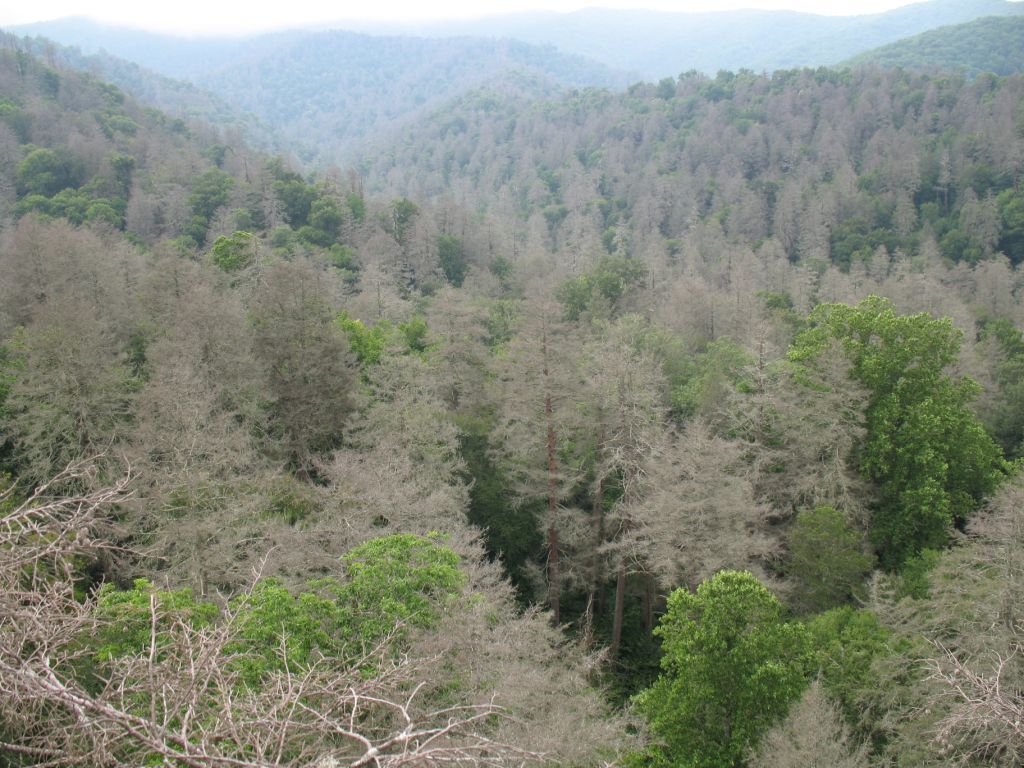
LARGE SCALE HEMLOCK DIE OFF IN THE SOUTHERN APPALACHAINS
This insect has become a relatively recent poster child for how disastrous invasive pests can be. These nearly microscopic little SOBs have rivaled chestnut blight for the speed at which they've spread and their virulence (granted the trees take a few years to succumb, but mortality is nearly 100% and unlike the chestnut, hemlocks lack the ability to re-sprout; once they're dead, they're dead). I've written about this so often mainly because I've witnessed the before and after of this plague first hand, and it has had a profound impact on me personally. Hemlocks were not particularly common in my area to begin with, so when you were lucky enough to come across a stand it made the ecological influence that the trees had on their environment even more profound. Overall, these places were quieter, cooler, and lusher than the surrounding woodland. As tragic as it has been to see this species all but wiped out in my area, where the hemlock are more common and a dominant species, their loss has been catastrophic and will permanently change the landscape they once called home.
While I could go on, and probably should, I'll leave you with an image of the current state of our forests relative to a decade ago. If anything these numbers have probably increased. You can see what it looks like for other parts of the east (here) as well and it ain't pretty. The reality is that soon enough they're may not be any species left to take the place of the ones that get wiped out... and where are we then? And just in case you weren't concerned enough, I'll leave you with a list of a few of the other wonderful human induced plagues that are currently ravaging woodlands up and down the east coast. Keep in mind I didn't even touch upon native disease/pests or other invasive plants... I can only fit so much negativity into one post.

- Asian Longhorned Beetle, Anoplophora glabripennis
- Emerald Ash Borer, Agrilus planipennis
- Beech bark disease, Cryptococcus fagisuga
- Dogwood anthracnose, Discula destructiva
- Viburnum Leaf Beetle, Pyrrhalta viburni
- Oak wilt, Ceratocystis fagacearum
- Dutch Elm Disease, Caused by 3 different species of ascomycete microfungi: Ophiostoma ulmi, Ophiostoma himal-ulmi, Ophiostoma novo-ulmi
- White Pine Blister Rust, Cronartium ribicola
- Chestnut Blight, Cryphonectria parasitica
IMAGE SOURCES: Thousand Cankers Disease Map, Butternut Canker Distribution Map, 2015 Forest Health Aerial Survey, Woolly Adelgid Spread Map, Dead Hemlocks, Northeast Tree Mortality Map
Wednesday, November 30, 2016
THE GARDEN(S) THAT ATE ME

We all have moments when we feel like the darker parts of our subconscious seep out to infiltrate our reality, even if just for a moment. It might happen a bit more often than I'd like, but I normally just brush it off and blame it on my over-active imagination and some combination of stress, exhaustion, and coincidence... but this past weekend was a bit exceptional.
I've been pretty desperate the past few weekends (and by "few" I mean since April) trying to get everything prepped and planted before the ground freezes... So I found myself the night after thanksgiving hacking away at the remains of a gravel road with an uncomfortably large number of winter moths fluttering past my head lamp, moving in and out of the cold fog that kept me from seeing much past the end of my pickaxe. Add this to the occasional muffled sound of howling coyotes, faint church bells, and the distant whirring of a passing train and I think any sane person would begin to question if they had wandered into a dream, or at the very least lost their grip on reality...
Getting to my point (I do have them occasionally) this odd out of body experience made me reflect on (not only my own sanity) but if the thing I was doing was really necessary at all. Given that nearly every bit of my free time has been consumed by my pursuit to "finish" the gardens I've started nearly 5 years ago I've been doing my best to try to be more efficient, or at the very least making sure the gardens don't consume me entirely. So while taking a pickaxe to the edge of a road may not have fallen under the category of completely necessary, with the complete lack of soil in certain areas and extreme compaction in others, I don't feel I was (completely) crazy for tearing it all up. BUT the reality is there are more than a handful of plants that are well equipped to deal with barely there heavily compacted "soils" that are a byproduct of current construction practices (a byproduct that at some point nearly every gardener has had to deal with). So if you would rather not rip up a road or that horrible corner of your yard where nothing will grow, consider these amazingly resilient plants that seem to bask in the compacted, clay-ey, gravel-ey poor excuse for soil that is an unfortunate and often overlooked cost of modern living.

Juncus tenuis - Poverty Rush or Path Rush
Zones 3-9
Find any old road in the northeast and this little guy is probably close by. An awkward little fella, but cute and mostly evergreen. Always a few darker shades green than the plants around it. I'm going to attempt to use it as a ground cover on the remainder of the old road I was hacking to pieces. Hopefully it works out.
Purchase from: (RETAIL) - Agrecol, Everwilde Farms, Ion Exchange, Niche Gardens, Morning Sky Greenery, Toadshade Wildflower Farm, Prairie Moon (WHOLESALE) - Northcreek Nursery, Midwest Groundcovers, New Moon Nursery

Ruellia humilis - Wild Petunia
Zones 4-8
By all accounts tough as nails and indifferent to soil. Planted a few during our drought this summer. Barely watered it. Didn't skip a beat. So far hasn't been browsed.
Purchase from: (RETAIL) - American Meadows, Agrecol, Butterfly Gardens to Go, Everwilde Farms, Heritage Flower Farm, High Country Gardens, Ion Exchange, J.L. Hudson, Seedman's, Lazy S'S Farm Nursery, Morning Sky Greenery, Prairie Nursery, Rare Find Nursery, Sunshine Farms and Gardens, Toadshade Wildflower Farm, Wildflower Farm (WHOLESALE) - Midwest Groundcovers, Northcreek Nurseries, New Moon Nurseries, Van Berkum Nursery

Symphyotrichum cordifolium - Blue Wood Aster
Zones 3-8
Other than being deer candy I have no complaints about this one. Its powder blue flowers are best appreciated in mass (and a great re-seeder so if you leave it to its own devices you'll have plenty in time). All sources list it as browse resistant, the local deer population says otherwise. Closely related a similarly adaptable species include S. drummondii S. ciliolatum, S. shortii, S. sagittifolium, and S. oolentangiense.
Purchase from: (RETAIL) - Amanda's Native Plants, Prairie Nursery, Prairie Moon Nursery (WHOLESALE) - Northcreek Nursery, New Moon Nursery, Van Berkum Nursery

Symphyotrichum novae-angliae - New England Aster
Zones 3-8
Always a bit obsessed with any species that seem to have a ridiculous (and seemingly pointless) level of diversity. All the populations I've come across have purples, light pinks, magentas, and everything in between. Its height is dependent on soil fertility. Gets a bit over rambunctious and floppy in overly rich ones.
Purchase from: (RETAIL) - Agrecol, Amanda's Garden, American Meadows, Everwilde Farms, Grimm's Gardens, High Country Gardens, Ion Exchange, Morning Sky Greenery, Prairie Nursery, Prairie Moon Nursery, Toadshade Wildflower Farm (WHOLESALE) - Midwest Groundcovers, New Moon Nursery, North Creek Nursery

Symphyotrichum pilosum - Frost Aster
Zones 3-8
I know this plant from my bike rides to work, growing happily in what looks like concrete alongside the railroad tracks. This plant will look like crap if you give it good soil, crappy soils of low fertility produce the best plants. Mainly white, but have come across light pink variants as well.
Purchase from: (RETAIL) - Agrecol, Ion Exchange, Prairie Moon Nursery, Plant Delights Nursery, Prairie Nursery, Toadshade Wildflower Farm (WHOLESALE) - New Moon Nursery

Scutellaria incana - Hoary or Downy Skullcap
Zones 4 (although I've seen a few 3 and 5)-9 (a few 8s too)
I'm a sucker for blue, and if it wasn't for the deer I would have given this guy a try. I've seen what they've done to deer resistant plants, can only imagine what they'd do to a plant without the resistance. Supposedly a fan of clays so extra bummer for me.
Purchase from: (RETAIL) - Easy Wildflowers, Everwilde Farms, Gardens in the Wood of Grassy Creek, Lazy S'S
Farm Nursery, Niche Gardens, Odyssey Perennials, Prairie Moon Nursery (WHOLESALE) - Forrest Keeling, Northcreek Nursery, New Moon Nursery
IMAGE SOURCES: J. tenuis (LEFT, RIGHT); R. humilis; S. incana (LEFT, RIGHT)
Monday, October 31, 2016
💀 ODE TO POISON 💀

The pseudo-branches of T. radicans in full fall splendor using adjacent trees as a scaffold.
So with the unavoidable ascendancy of the evil pumpkin king (aka the Trump) and the coming nuclear Trump-ocolypse® I thought I'd pay homage to one of the plants that will surely thrive after the nuclear holocaust and eventually usurp the great Trumpkin on its path to world domination. Toxicodendron radicans aka Poison Ivy aka our future plant overlord aka the current bane of my existence is quite ubiquitous 'round my neck of the woods (literally... its f***ing everywhere in the woods) and like many gardeners in the northeast I have gone to battle many times with this plant and always come back the loser.
Despite the ongoing war, my respect for this wondrous creature remains constant. It is the only plant I know of that can be found in both highly disturbed successionary as well as pristine climax plant communities (and everything in between). Sun, shade, dry, wet, vertical, horizontal; this plant's fine tuned genetics give it a level of phenotypic plasticity that is unparalleled in the plant world (or at least in the northeast anyway). It's an outlier in habitat succession & evolution in its ability to persist in whatever conditions it finds itself in, and simply adapts in place. Add this steel like constitution with the ability to cause one of the most uncomfortable and nasty looking allergic reactions around (and potentially disfiguring/life threatening if the reaction is severe enough) and you start to think that its super villain name-sake is actually no match for the actual plant... suck it Uma. So to go along with this super toxic, super adaptable plant I give you few other resolute toxic beauties east of the rockies that are a bit more people friendly (unless you eat them... but now you know better... so don't). Anyway if you like to live dangerously and more traditional plants just aren't cutting it, give one of these guys a try.

Aconitum uncinatum - Climbing Monkshood, Southern Blue Monkshood
Zones 5-8
The lore surrounding this genus's use as a potent poison dates back to about as long as people have had written language. As toxic as it is beautiful, A. uncinatum is no exception and one of the best garden subjects of the handful of species that call North America home. At its best when it has a few sturdy neighbors to ramble through and shade it during the hottest times of the day and like every other member of the genus not a fan of drought (or even moderately dry soil for that matter).
Purchase from: Enchanter's Garden, Far Reaches Farm

Eupatorium rugosum syn. Ageratina altissima - White Snakeroot
Zones 4-9
Despite my darndest attempt to stay strong, I've given in to temptation and left this plant in the garden which I'm sure I will more than regret as I pull up hundreds upon hundreds of seedlings that will inevitably pop up on every square inch of bare soil within shooting distance. Aggressive self seeders to say the least and also as far as I can tell, super toxic. One of the few plants that I have never seen get even a nibble. The cause of milk sickness, which was attributed to thousands of deaths of early European settlers in the east until someone had the foresight to ask the people who had lived here for thousands upon thousands of years prior. We thanked them by stealing their land and forgetting the name of the Shawnee woman who may have prevented thousands more from being poisoned.
Purchase from: Morning Sky Greenery, Prairie Moon Nursery, American Meadows, White Flower Farm, Niche Gardens, Forest Farm, Lazy S'S Farm, New Garden Plants, Secret Garden Growers
Euphorbia corollata - Flowering Spurge
Zones 3-9
I do my best to try to look at my clay soils as an asset, and while I do a pretty good job most of the time this is one of the plants that sends me a bit off course. But, if you are blessed with sterile freely draining soil you owe it to yourself to grow this plant. It shares the milky irritating latex typical of the genus that oozes from any part of the plant if cut, torn, or otherwise munched on. Unlike the other members its the actual petals rather than bracts that are the showy part of the inflorescence. Spectacular fall color, perhaps one of the best of any native herbaceous perennial in our flora.
Purchase from: Prairie Moon, Avant Gardens, Everwilde Farms, Heritage Flower Farm, Lazy S'S Farm, Niche Gardens, Plant Delights, Midwest Groundcovers, Ion Exchange, Rare Find Nursery, Agrecol

Oxytropis lambertii - Purple Locoweed
Zones 3-8
So named for the behavioral effect it has on livestock after it causes irreversible neurological damage once consumed. However the active toxin (swainsonine) is only produced in association with a symbiotic fungus. Ranchers once offered bounties for this plant and its relatives in the range lands of the west, but so long as cattle aren't an issue, and you have a dry sunny bit of land to keep this guy happy, a very worthy long lived garden subject.
Purchase from: Everwilde Farms, Prairie Moon

Toxicodendron radicans - Poison Ivy
Zones 4-10
See overly elaborate description at the top of the page.
Purchase from: WHY?!!!

Veratrum viride - Green False Hellebore
Zones 3-8
It and its brother from another mother (Symplocarpus foetidus) are quite the pair. Both emerge early and herald the triumphant return of spring with lush bold foliage that gives northeastern forests a tropical, almost primordial feel early in the season. The only problem with springing to life when there's not much other green around is your an easy target so V. viride employs a toxic alkaloid that makes it a little less appealing to voracious winter starved herbivores.
Purchase from: Could only find one western source :/ Far Reaches Farm
IMAGE SOURCES: A. uncinatum (LEFT, RIGHT); E. corollata (LEFT, RIGHT, BOTTOM); O. lambertii (LEFT, RIGHT); V. viride (LEFT, RIGHT)
Friday, September 30, 2016
GIFTS FROM MY GRANDFATHER

Recently rediscovered blueberry and asparagus in my garden
So I guess I should probably start with the fact that I never knew my grandfather. I'd like to think I got glimpses of him whenever I'd talk with my grandmother, or my mum, but truthfully I'd never spoken about him much with either. But despite this, even though I never knew him, I feel like he probably had just as much of an impact on my life (if not more) than anyone alive who I am close to.
I suppose I should back up just a bit. My parents were fortunate enough to inherit 2 properties from my grandparents, and it is on one of these where I do pretty much all of my gardening these days. Even now, after exploring the property for well over ten years, I still stumble across things my grandfather planted decades before. Granted there are the standard functional plants like blueberries, asparagus, pears, grapes, quince & apples, (a house isn't a home till it has at least a few good clumps of asparagus and blueberry bushes) along with your standard non-functional flowers (daffodils, anemone, forsythia, and lilacs). But even back long before "native" became part of the common lexicon he planted things like trillium and tamarack. I have no idea where he would have gotten these plants or how he would even have known to plant them but he seemed to have managed to do both.
So while I don't think I'm going to able to definitely prove there is a plant dork gene any time soon, if there is I'm pretty sure I know where mine came from. And so in honor of my grandfather, this month I give you 2 of his plants along with a 2 I'm pretty sure he would have been fans of if he had grown them. Functional (aka edible), beautiful, and underappreciated in the landscape. I think he would approve.

Asparagus officinalis - Asparagus
Zones (3)4-8
Maybe a bit hard to accomodate outside of the vegetable garden, but this classy vegetable is even classier plant. Delicate ferny foliage, adabtable, amazing fall color. Don't know why we don't use it more in the landscape. An alternative to some of the more ubiquitous ornamental grasses. Usually dioecious. Grown around the world. Many selections have been made... check it out.
Purchase from: Seed Savers Exchange, Johnny's Selected Seeds, Stark Bro's, Gurnery's, Jung Seed, Harvest Nursery, Oikos Tree Crops

Cydonia oblonga syn. Cydonia vulgaris - Quince
Zones 5-7(8)
This plant is probably as nostalgic as it gets for me (as it probably has been for generations of people as its been grown and cultivated for thousands of years). There was (and still is) a small quince hedgerow (courtesy of my grandfather) that bordered the property at my grandmothers place. I've always thought of them as the apple's richer cousin, showier in all aspects, but somehow still more refined. They develop a beautiful tortured character with time, with twisted muscular looking branches, and an irregular crown. And then of course there's the fruit, which is a whole thing in itself. Typically it needs to be cooked first before its eaten (fruit is typically very dense and hard), but there are selections that have been made that do have fruit that can be eaten right of the tree (including 'Aromatnaya,' 'Kuganskaya,' and 'Pineapple'). There is a closely related species, Pseudocydonia sinensis or Chinese Quince, that, while not as hardy (z6) has bark that can rival pretty much any ornamental available.
Purchase from: Forest Farm, Harvest Nursery, Jung Seed, Stark Bro's, Oikos Tree Crops

Passiflora incarnata - Maypop or Wild Passion Flower
Zones (5)6-9
The (or one of the, with maybe P. lutea coming in first) cold hardiest members of the genus. If there were ever an exotic looking plant this is it. An aggressive runner where it's hardy spreading in a similar manner to Hedge Bindweed (Calystegia sepium) but maybe with a little less wanderlust. This is one of those plants with fruit that is at its best when it looks its worse. Dull off-yellowish, slightly shriveled, and dimpled when ripe. Native to the mid-atlantic and south. Fruit with a similar structure to a pomegranate.
Purchase from: Prairie Moon, Almost Eden, Brushwood Nursery, Companion Plants, Everwilde Farms, Lazy S'S Farm, Logee's, Niche Gardens, Rare Exotic Seeds, Smart Seeds, Sunlight Gardens

Vaccinium macrocarpon - Cranberry
Zones 2-6(7)
When I say "cranberry" you say "bog." Cranberry!.. Bog!.., Cranberry!.. Bog!.. WRONG!!! You don't need a bog to grow this trailing ericaceous evergreen. Happy to adapt to average garden soils as long as they're not too droughty. An underused and undervalued plant in the industry.
Purchase from: Harvest Nursery, Seed Saver's Exchange, Stark Bro's, Jung Seed, Dancing Oaks Nursery, Gurney's, Forest Farm
IMAGE SOURCES: A. officinalis (LEFT, RIGHT), C. oblonga, (LEFT, RIGHT), P. incarnata, (LEFT, RIGHT), V. macrocarpon (LEFT, RIGHT)
Subscribe to:
Posts (Atom)